

Intent data has changed the way B2B organisations identify demand.
Instead of waiting for prospects to complete a form, request a demo or speak directly with Sales, marketing teams can now see signs of buying activity much earlier. Research behaviour, content consumption and topic engagement can all indicate that an organisation is beginning to explore a problem or evaluate potential solutions.
As we explored this in our previous blogs, this gives revenue teams a valuable advantage. It helps them identify accounts that may be moving into market and engage earlier in the buying journey.
But identifying activity is only one part of the challenge.
Enterprise buying decisions are rarely made by a single individual, and they are almost never driven by a single motivation. Behind every account showing intent sits a group of people with different responsibilities, priorities and definitions of value.
That is where account-level intent can start to become misleading.
An account does not make a buying decision
Intent platforms naturally organise activity around accounts. A company may be described as “surging”, “in-market” or demonstrating high levels of interest in a particular category.
That helps with prioritisation, but it can create the impression that the organisation is moving through the buying journey as one unified decision-maker.
In reality, enterprise purchases are usually shaped by a buying committee.
A CIO may be focused on long-term technology strategy and architectural fit. A Finance Director may be assessing return on investment and commercial risk. Procurement may focus on supplier credibility and contractual terms. Security teams may prioritise governance and compliance, while Operations may focus on implementation, continuity, and internal disruption.
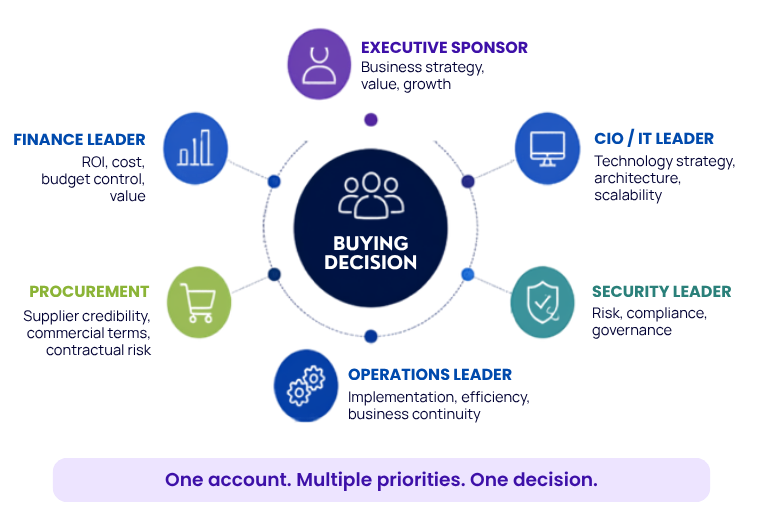
All of these people can evaluate the same solution at the same time, yet each may do so for a different reason.
That matters because the same message is unlikely to resonate equally with all of them.
A technical case study may strengthen an IT stakeholder's confidence but do little to answer Finance's questions about value. A bold innovation message may appeal to a transformation leader while making a risk-conscious stakeholder more hesitant. An executive summary may help a sponsor understand the strategic case but leave a technical evaluator without the detail required to move forward.
Intent data can show that the account is active.
It cannot, on its own, explain how each person inside that account is interpreting the opportunity.
Similar intent can hide very different buying motivations
Consider two enterprise organisations researching the same cybersecurity platform.
Both companies have consumed analyst reports, visited product pages, engaged with technical content, and shown increasing activity over several weeks.
From an intent perspective, the two accounts may look remarkably similar.
Yet the context behind that behaviour could be very different.
The first organisation may have experienced a recent security incident. Senior leadership is under pressure to reduce risk, improve governance and reassure customers. The buying committee is therefore evaluating potential vendors through the lens of resilience, compliance and implementation confidence.
The second organisation may be in the middle of a broader digital transformation initiative. It is modernising infrastructure, consolidating platforms and investing in technologies that can support future growth. Security matters, but it is being evaluated alongside scalability, flexibility, and innovation.
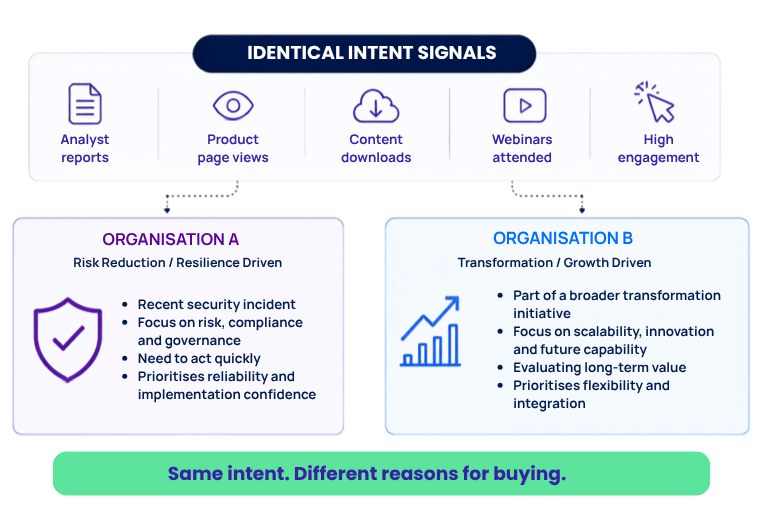
Both organisations are researching the same category.
Both may generate equally strong intent signals.
But they are not buying for the same reason.
If both accounts receive the same messaging, the same content journey and the same sales approach, one of those conversations may feel relevant while the other feels generic.
The intent signal is not wrong. It is simply incomplete.
This is the distinction revenue teams need to understand: intent reveals behaviour, but behaviour still requires interpretation.
The buying committee makes interpretation harder
The challenge becomes even more complex because differences do not exist only between accounts. They also exist within the buying committee itself.
A single organisation can contain several stakeholders who are all highly engaged but motivated by different outcomes.
For example, a CIO might see a new enterprise platform as a route to greater scalability and strategic flexibility. Finance may view the same investment primarily through the lens of cost reduction and return. Security may be assessing whether it introduces or reduces organisational risk. An Operations leader may focus on implementation effort and disruption.
These are not minor differences in messaging preference. They can determine whether consensus forms at all.
Enterprise buying often slows down not because there is insufficient interest, but because different stakeholders are trying to resolve different questions.
This helps explain why some apparently high-intent opportunities fail to progress. The account may be active, but the buying committee may not yet be aligned.
One stakeholder may be convinced while another remains sceptical. A technical team may favour the solution while Finance questions the business case. Procurement may introduce concerns late in the process that were never addressed earlier. The executive sponsor may support the strategic direction but lack confidence in execution.
An account-level intent score cannot fully capture those dynamics.
To influence the decision, revenue teams need to understand not only whether the organisation is interested, but also who is shaping the decision and what each stakeholder needs to believe before they can move forward.
Why more data is not necessarily the answer
When high-intent accounts fail to convert, the instinctive response is often to collect more information.
Another intent provider may offer additional signals. A new platform may promise a more sophisticated scoring model. Behavioural datasets can provide deeper engagement visibility. AI systems can process increasingly large volumes of activity.
These capabilities can absolutely improve account prioritisation. But at some point, more visibility stops solving the real problem.
If a team already knows an account is researching a solution, adding ten more signals confirming the same thing may not materially improve the next sales conversation.
The more important questions are often different:
- Why has the buying journey started now?
- Which business problem is creating urgency?
- Who is influencing the decision?
- What does success look like for each stakeholder?
- Where is resistance likely to emerge?
- What kind of evidence will build confidence?
- How should the conversation change depending on who is involved?
Those are not simply data collection questions.
They are interpretation questions.
The difference matters because the value of buyer data does not come from how much of it an organisation possesses. It comes from whether that information helps Marketing and Sales make better decisions.
Moving from behavioural data to buyer understanding
This is where Buyer Intelligence becomes useful.
Buyer Intelligence does not replace intent data. It adds context around it.
Intent remains one of the strongest ways to understand whether demand may be developing. What it cannot always provide is the human and organisational context behind that demand.
A more complete view brings together three complementary layers.
Intent Intelligence: What is happening?
Intent Intelligence identifies behavioural signals that suggest an organisation is researching a particular category, challenge or solution.
It helps revenue teams recognise emerging demand, prioritise accounts and engage earlier.
The question it answers is relatively straightforward:
What is the buyer researching?
That insight provides the starting point.
Psychographic Intelligence: How is the buyer likely to evaluate?
Two people with the same job title, seniority and company profile can still make decisions very differently.
One buyer may be highly analytical and want detailed evidence before engaging further. Another may prefer hands-on exploration, demonstrations and practical examples. One may be motivated by innovation, while another is more concerned with reducing uncertainty and risk.
Psychographic Intelligence adds this behavioural context.
It helps teams understand factors such as decision-making style, risk tolerance, communication preferences, trust drivers and preferred ways of engaging.
Instead of treating every CIO, CFO or technical evaluator in the same way, teams can adapt their approach to the person behind the role.
The question becomes:
How is this stakeholder likely to process the decision?
Buying Committee Intelligence: How will consensus be built?
The final layer considers the organisation as a group of decision-makers rather than a collection of individual leads.
Buying Committee Intelligence helps teams identify which stakeholders are involved, what each person cares about and where competing priorities may create friction.
The objective is not simply to map job titles. It is to understand how the decision is likely to move through the organisation.
- Who is the sponsor?
- Who is likely to challenge the business case?
- Who needs technical reassurance?
- Who controls budget?
- Who could slow the decision down?
- Who needs to become an internal advocate?
This context helps Marketing and Sales coordinate engagement across the full buying group instead of over-relying on a single contact.
Better buyer understanding changes the conversation
Once you combine these layers, intent becomes much more actionable.
Consider again the two organisations researching the same cybersecurity solution.
For the risk-driven organisation, the most effective engagement may focus on resilience, governance, implementation confidence and evidence from similar businesses.
For the transformation-led organisation, the conversation may need to emphasise flexibility, integration, scalability and future capability.
The same principle applies within each account.
A Finance stakeholder may need a commercial business case. A Security leader may want proof of risk reduction. A CIO may need confidence that the platform supports the long-term technology roadmap. An operational stakeholder may need clarity on rollout and adoption.
The core product has not changed. The relevance of the conversation has.
This is where personalisation becomes more meaningful. It moves beyond inserting a company name into a campaign or adapting content by job title. It becomes about aligning engagement with the motivations and decision criteria of the people involved.
The next evolution of intent-led ABM
Intent data remains essential to modern ABM.
Without it, organisations risk identifying demand too late and engaging buyers only after competitors have already shaped the conversation.
But intent should be treated as the beginning of buyer understanding, not the end.
The next stage of ABM is less about collecting more signals and more about interpreting the signals organisations already have. That means understanding what is driving the buying journey, who is involved and how different stakeholders are likely to evaluate the decision.
At Think ABM, this is the thinking behind the combination of Sales Nitro™ and InsightsIQ™.
Sales Nitro™ helps identify and prioritise buying activity using intent intelligence. InsightsIQ™ adds psychographic insight to help teams understand how individual stakeholders are more likely to evaluate, communicate and engage. Combined with buying committee intelligence, these signals give revenue teams a clearer view of the people behind the account.
The result is not simply more buyer data. It is better context for the conversations that follow.
Because in complex B2B buying, knowing that an account is interested is useful.
Understanding why the people inside it are interested, what matters to them and how they will reach a decision is what turns that interest into meaningful progress.
Psychological precision. Better conversations.
Frequently Asked Questions
Frequently Asked Questions
What is a buying committee in B2B?
A buying committee is the group of stakeholders involved in an enterprise purchase. It can include decision-makers from IT, Finance, Procurement, Security, Operations and executive leadership, each with different priorities and concerns.
Why isn't intent data enough on its own?
Intent data shows what an account is researching or engaging with, but it does not fully explain why the activity is happening, what motivates individual stakeholders or how the buying committee will reach a decision.
What is Buyer Intelligence?
Buyer Intelligence combines intent, psychographic and buying committee insights to give revenue teams a clearer understanding of what buyers are researching, how they make decisions and who influences the purchase.
How does psychographic intelligence improve ABM?
Psychographic intelligence helps teams understand differences in decision style, risk tolerance, communication preferences and engagement behaviour. This allows Marketing and Sales to adapt messaging to how individual buyers prefer to evaluate information.