

Intent data can indicate that an account is researching a particular problem, category, or solution. Still, by itself, it cannot tell sales whether that account needs immediate attention.
B2B teams should prioritise accounts by combining three factors:
- How well the account matches the ideal customer profile.
- How commercially meaningful its intent signals are.
- How recently and consistently those signals have appeared.
Together, these factors create a 60-point Account Opportunity Score. The score helps marketing, sales and revenue operations distinguish meaningful account movement from research noise before deciding where to focus.
Why raw intent data creates false urgency
Not every account generating intent is a qualified opportunity.
One account could show a sudden rise in research activity yet still be outside the target market; another might exactly match the ideal customer profile but produce only a single, isolated signal; and a third could show only moderate intent across several relevant topics over several weeks.
If accounts are ranked only by activity volume, the first account often rises to the top. But it may not be the account most likely to progress. Intent data becomes useful when it is interpreted in context.
That context begins with three questions:
- Is this an account the business is equipped to serve?
- Does its behaviour indicate commercially relevant research?
- Is the activity recent and gaining momentum?
The Account Opportunity Score provides a consistent way to answer those questions.
The 60-point Account Opportunity Score
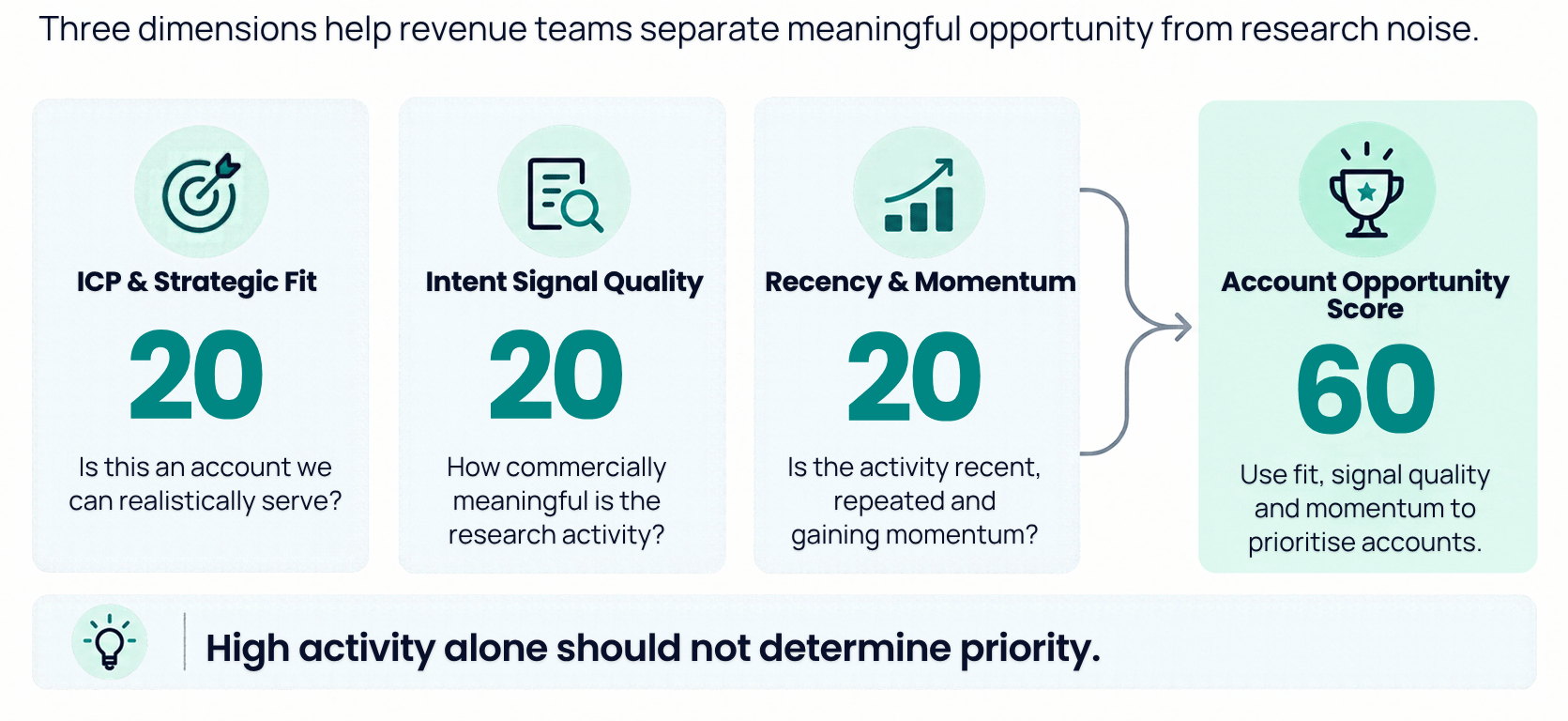
The framework distributes 60 points across three dimensions.
Each dimension prevents a different kind of prioritisation error.
ICP fit prevents teams from chasing active but unsuitable accounts. Signal quality separates general interest from meaningful buying research. Recency and momentum prevent teams from treating old or isolated activity as current demand.
1. ICP and strategic fit: 20 points
Intent is valuable only when it comes from an account the organisation can realistically serve.
The first part of the score should therefore evaluate the account against the ideal customer profile. Depending on the business, the assessment may include:
- Industry or market segment.
- Company size and revenue.
- Geography.
- Technology environment.
- Regulatory or operational requirements.
- Existing product fit.
- Strategic account status.
- Historical conversion patterns.
A simple scoring scale can be used:
The purpose is not to reward an account for matching every available firmographic field. It is to determine whether the account has the characteristics associated with genuine customer value and successful delivery.
A large company should not automatically receive a high score. If the organisation lacks geographic coverage, relevant capabilities, or a suitable commercial model, it may still be a weak opportunity.
ICP scoring should reflect practical fit, not brand recognition.
2. Intent signal quality: 20 points
The second dimension examines what the account is researching and how closely that activity relates to a potential buying decision. Intent signals vary considerably in commercial significance.
General educational research may indicate awareness of a problem. Comparison pages, implementation guidance, pricing content, vendor evaluations and solution-specific research usually indicate a more advanced investigation.
Signals can be grouped into three broad levels:
Low-intent signals
These indicate early interest but provide little evidence of an active buying process.
Examples include:
- Reading a general industry article.
- Visiting a homepage once.
- Engaging with broad thought-leadership content.
- Researching a loosely related topic.
- Interacting with a single social post.
Medium-intent signals
These suggest that the account is exploring a defined problem or solution category.
Examples include:
- Reading several related articles.
- Returning to product or service content.
- Researching use cases.
- Attending a relevant webinar.
- Reviewing operational guides or frameworks.
High-intent signals
These indicate the account may be evaluating options or preparing to act.
Examples include:
- Visiting solution or product pages repeatedly.
- Viewing vendor-comparison content.
- Researching implementation requirements.
- Reviewing pricing, case studies or commercial outcomes.
- Investigating several closely related decision-stage topics.
The score should consider both the strength and the breadth of the evidence.
One strong signal may justify additional monitoring. It should rarely be treated as sufficient evidence for immediate sales outreach.
3. Signal recency and momentum: 20 points
Intent loses relevance over time.
An account that conducted substantial research three months ago may no longer be evaluating the problem. Conversely, several signals appearing across a few days may indicate that internal interest is developing quickly.
The third dimension therefore evaluates:
- When the most recent signal occurred.
- Whether activity is increasing or declining.
- How frequently signals are appearing.
- Whether research spans multiple sessions.
- Whether new topics suggest progression through the buying journey.
A practical scoring scale might look like this:
Momentum matters because B2B buying processes rarely move through a single isolated interaction. A pattern of connected behaviours is more useful than a single spike.
For example, an account that moves from educational research to integration guidance and then to vendor comparisons shows more meaningful progression than an account that repeatedly consumes unrelated content.
Apply suppression rules before prioritisation
Exclude or review some accounts before their scores enter the sales-prioritisation process.
Common suppression criteria include:
- Accounts outside the addressable market.
- Competitors conducting research.
- Students, consultants or job seekers.
- Existing customers researching support topics.
- Duplicate or incorrectly identified accounts.
- Activity generated by internal employees.
- Signals unrelated to the organisation’s products or services.
Suppression rules protect sales teams from false positives and preserve confidence in the scoring model. A high volume of activity should never override a clear disqualification condition.
Worked example: three accounts showing intent
Consider three accounts identified during the same week.
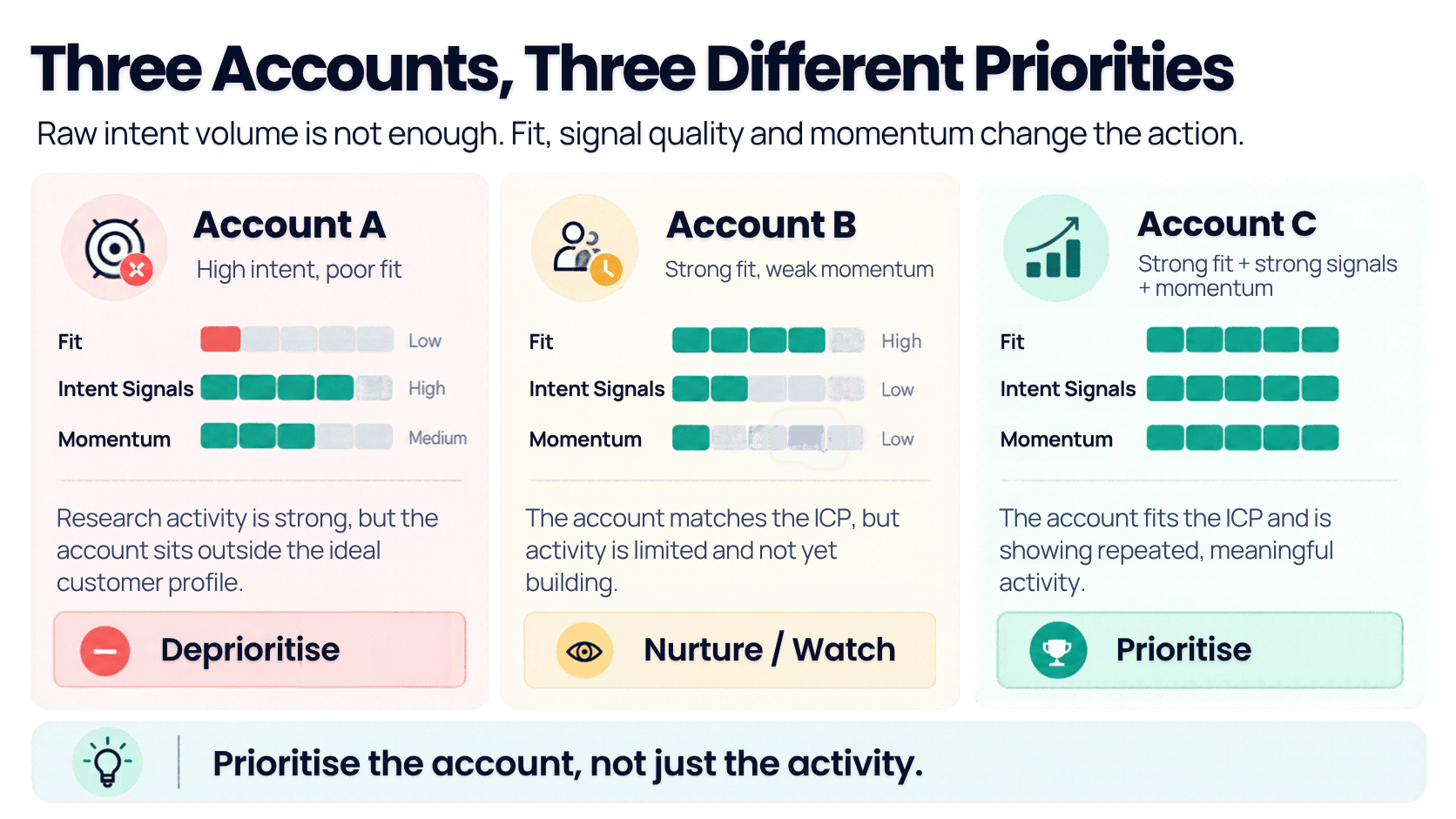
Account A: high activity, poor fit
Account A has generated strong and recent intent. However, it falls outside the organisation’s target geography and doesn't meet key commercial-fit criteria.
Its activity is worth understanding, but it should not displace stronger target accounts simply because it generated more signals.
Account B: strong fit, insufficient evidence
Account B closely matches the ICP, but its activity consists of a small number of early-stage signals without recent momentum.
This account belongs on a watchlist or in a targeted nurture programme. The evidence does not yet support urgent sales action.
Account C: the strongest opportunity
Account C combines strong fit with relevant, recent and increasing research.
It may not have generated the highest raw volume of activity, but its complete pattern creates the strongest Account Opportunity Score.
This is why account prioritisation should evaluate the quality and context of intent—not merely the number of signals detected.
How to interpret the 60-point score
The score can be translated into three provisional opportunity levels.
These thresholds should be treated as starting points.
Every organisation has different sales cycles, markets, data sources and conversion patterns. The model should be calibrated against actual opportunity creation and revenue outcomes.
If accounts scoring between 35 and 40 regularly convert, the threshold may need to move down. If highly scored accounts rarely progress, you may need to change the weighting or underlying signals.
The purpose of scoring is not to create artificial certainty. It is to improve the consistency of prioritisation decisions.
How to implement the model
A prioritisation framework is only as reliable as the data it feeds on. Revenue teams need timely account identification, topic-level intent, changes in research momentum and connected CRM context. Sales Nitro™ brings these signals into a clearer account-level view, letting teams apply consistent prioritisation rules instead of manually reviewing disconnected activity.
Define the evidence behind every score
Document what earns points in each dimension. Sales and marketing should be able to understand why an account received its score.
Avoid creating a model that depends on hidden calculations or unexplained data-provider labels.
Use ranges instead of excessive precision
An account scoring 47 may be little different from one scoring 48.
Focus on opportunity bands and the evidence behind them rather than treating small numerical differences as definitive.
Display the contributing factors
The total score should be accompanied by its components.
A sales representative should be able to see whether an account ranked highly because of strong ICP fit, recent research, decision-stage behaviour or a combination of all three.
Review changes, not only current totals
A rising score may be more important than a high but static score.
Track how account scores change over time and alert teams when an account crosses an agreed threshold or demonstrates rapid momentum.
Compare scores with pipeline outcomes
Review which accounts become accepted opportunities, progress through the pipeline and generate revenue.
Use those results to refine the scoring model rather than assuming the initial weighting will remain correct indefinitely.
What the Opportunity Score does not tell you
A strong Opportunity Score answers one important question:
Is this account worth prioritising?
It does not yet answer:
- Which stakeholders are involved?
- Whether the buying committee is sufficiently developed?
- Which person should sales approach first?
- Whether the account is ready for direct outreach?
- What message or channel should be used?
- Whether marketing should nurture the account before sales engages?
Those decisions require additional buying-committee, CRM and engagement context.
That is the purpose of the second part of this series: the 40-point Activation Readiness Score.
From account opportunity to activation readiness
Intent data becomes valuable when it improves a real prioritisation decision.
The 60-point Account Opportunity Score gives revenue teams a consistent way to determine whether an account deserves attention. It combines fit, signal quality and momentum so that activity volume does not become a substitute for buying readiness.
But identifying a strong opportunity is only the first step.
Before sales acts, the organisation must understand the stakeholders involved, the existing relationship, and whether enough evidence justifies direct engagement.
Sales Nitro™ helps B2B revenue teams identify target accounts showing meaningful movement, connect behavioural signals with account and buying-committee context, and translate that intelligence into clearer engagement priorities. The framework in this blog post provides a practical decision layer for applying those signals consistently.
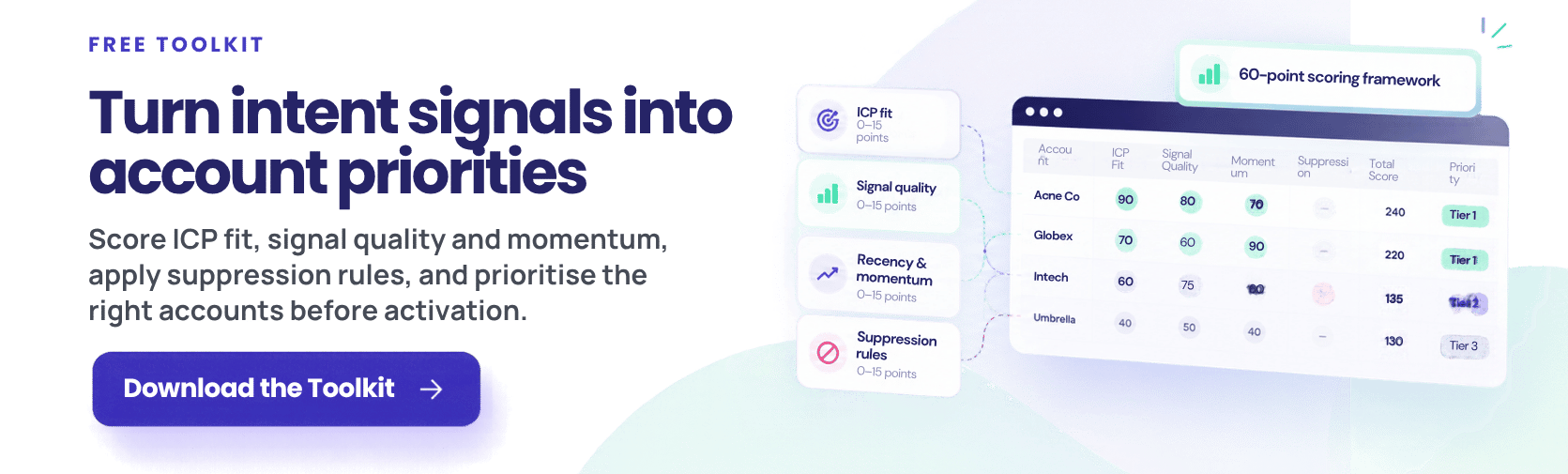
Want to apply the scoring framework to your own target accounts? Download the Think ABM Account Opportunity Scoring Toolkit to score ICP fit, intent signal quality and recency/momentum, document the evidence behind each score, apply suppression rules and compare account priority before moving into activation readiness.
Psychological precision. Better conversations.
Frequently Asked Questions
What is B2B intent scoring?
B2B intent scoring evaluates account research behaviour alongside account fit and timing signals. Its purpose is to help marketing and sales teams distinguish meaningful buying activity from general interest.
Should intent data be used without ICP data?
No. Intent data indicates research activity, but ICP data determines whether the account is commercially relevant. Using intent without fit criteria can cause teams to prioritise active accounts that are unlikely to become suitable customers.
How recent should an intent signal be?
The right timeframe depends on the buying cycle length and the signal's nature. Recent activity should generally carry more weight, while older signals should decline in value unless new research appears.
Can one high-intent signal justify sales outreach?
Usually not. One signal may justify monitoring or further research, but direct outreach should normally require supporting evidence such as ICP fit, repeated activity, buying-group coverage or existing engagement.
Should sales teams see the account score?
Yes, but they should also see the evidence behind it. A number without context doesn't help a salesperson decide whom to contact or what conversation to start.