

A marketing-qualified lead can absolutely be worth nurturing even if they're not ready for a sales conversation. That's the very point at which so many B2B handoffs go wrong. Marketing will have seen the engagement and the fit. Sales will be looking for a buying situation. RevOps is left in the middle trying to reconcile two very different definitions of 'qualified'.
The outcome is all too familiar: Marketing reports a constant stream of MQLs, Sales rejects or ignores most of them, and both sides end up blaming the other for poor pipeline quality. The real issue is rarely one of effort. It's an acceptance model which treats interest, intent and sales readiness as if they're all the same
An MQL should indicate that a person or account is worth further attention. A sales-ready opportunity with better qualification context should have enough evidence for Sales to take a specific next step. It's not just a higher score. It's the quality and completeness of the buying evidence that underpins it.
MQL vs a sales-ready opportunity
An MQL is a lead or account that Marketing has identified as relevant and meaningfully engaged. A sales-ready opportunity has further evidence of a problem, buying activity, stakeholder relevance and a realistic path to a commercial conversation.

The terminology varies from organisation to organisation. Some groups will have a sales-accepted lead in between MQL and SQL. Others will only create an opportunity after discovery. The labels matter less than having a common definition of what must be in place before Sales takes ownership.
This distinction protects both teams. Marketing can recognise meaningful engagement without overstating readiness. Sales can accept leads based on evidence rather than instinct, while returning early-stage accounts to nurture without treating them as failures.
Why Sales rejects marketing qualified leads?
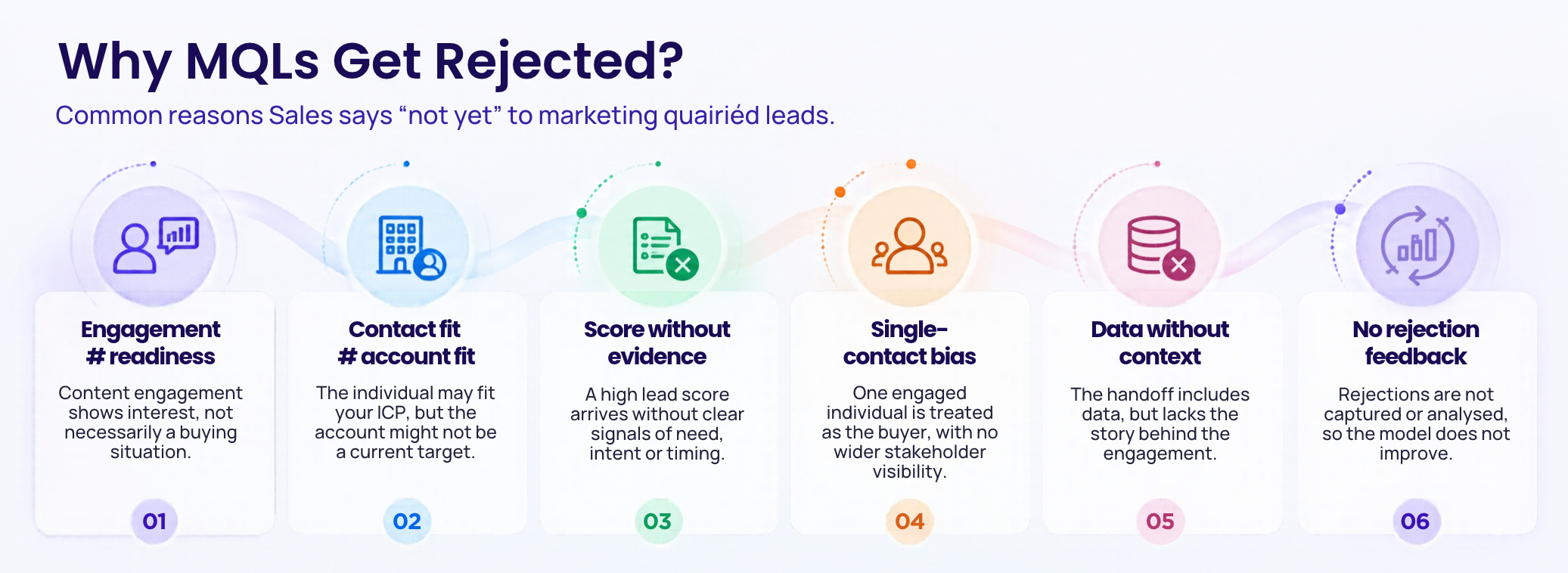
Engagement is mistaken for readiness
A download, webinar registration or pricing-page visit is useful evidence. It doesn't prove that a buying process is actually happening, though. It could be a researcher, a consultant, a student, a competitor or an employee doing it on behalf of someone else. Behaviour should trigger further assessment, not an automatic Sales handoff.
The contact fits, but the account does not
A senior job title can earn a high score even when the organisation is outside the ideal customer profile. The other way around too: you can end up with a strong-fit account simply because one of the organisation's junior people got involved, even if you still don't know the buying group or the actual business need. Enterprise qualification must evaluate the account and the people within it.
A score arrives without the evidence behind it
A score of 82 tells Sales that a threshold was crossed. It does not explain what changed, how recently it changed, which topics were researched or why the account deserves attention now. When the model is opaque, sellers either repeat the research or distrust the handoff.
One person is treated as the buyer
Complex B2B decisions are made by groups. A content consumer may be a researcher, technical evaluator, champion or blocker rather than the economic buyer. Sales readiness depends in part on whether the team understands the stakeholder's role and has a credible path to the rest of the committee.
The handoff contains data but no context
CRM fields can be complete, and the commercial story can be entirely absent. Sales need to know what the account appears to care about, what signals have created the priority, what's still uncertain and what the appropriate message or next step is. Data completeness is not the same as decision usefulness.
Rejection does not improve the model
If Sales can only mark a lead as rejected, Marketing learns very little. A lead rejected for poor account fit needs a different correction than one rejected for early timing, missing stakeholder coverage, or insufficient evidence. You need structured reasons for the rejection to drive the right corrective action. Without structured reasons, the same weak handoffs continue.
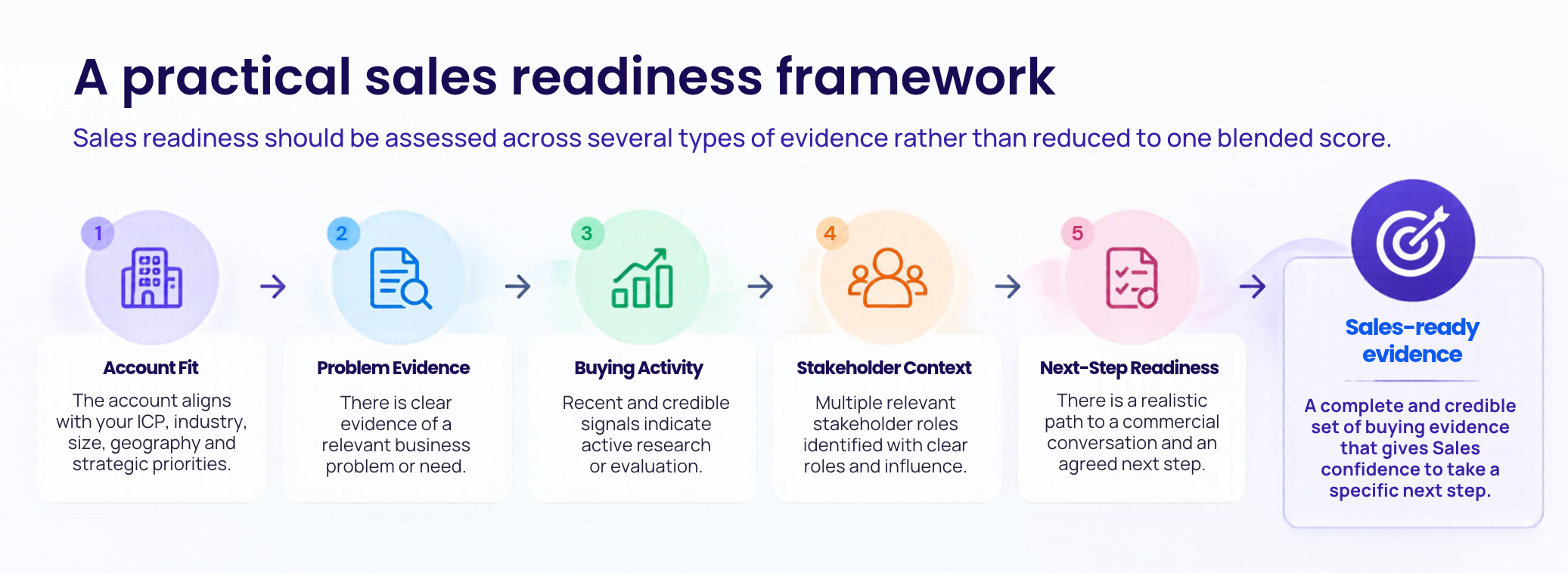
A practical sales readiness framework
Assess sales readiness across several types of evidence rather than reducing it to one blended score.
- Account fit: does the organisation fit the industries, size, geography, use cases, and commercial conditions the business can serve well?
- Problem evidence: is there evidence of a relevant need, change, initiative, risk or operational problem rather than just generic interest in the topic?
- Buying activity: are the signals meaningful, recent and consistent enough to indicate active evaluation? This could be a mix of first-party engagement, intent data and CRM history.
- Stakeholder context: who is involved, what role might that individual play, and is there a pathway to other members of the buying committee?
- Next-step readiness: Is there a credible reason for Sales to engage now, and can the team identify an appropriate message, question or action?
BANT can still provide useful evidence, particularly around need and timing. But using Budget, Authority, Need, and Timing as a rigid early-stage gate can lead teams to record a level of certainty they don't have. In complex enterprise purchases, teams may create a budget after validating the problem, and authority may be distributed across a buying committee. The handoff has to be clear about what is known, what is inferred and what Sales still needs to go and find out.
How to improve MQL acceptance?
- Define acceptance before building the score
Marketing, Sales and RevOps should agree on the minimum evidence required for acceptance, what Sales commits to do after accepting, and which conditions send a lead back to nurture. - Separate fit from readiness
Keep account fit, engagement, intent, stakeholder coverage and qualification evidence visible as separate dimensions. Use a blended score to support prioritisation, but don't let it hide why an account crossed the threshold. - Attach an evidence summary to every handoff
State the reason why the lead is being passed over at this point. Include the relevant signals (and their recency), the topics/needs that they indicate, the known stakeholders, CRM history, the uncertainties and a recommended next step. - Route by situation rather than score alone
A high-fit account with early interest could be a candidate for an account nurture programme. A high-intent account with poor fit may need validation. A strong-fit account with new buying activity and stakeholder context is one we'd want to go to immediately. - Use a response agreement
Define how quickly Sales will look at a handoff, what constitutes acceptance and how long Sales have to carry out the first action. You can't assess a qualification model if the accepted leads simply sit there unattended. - Create structured rejection and recycle reasons
Use a small, consistent taxonomy (poor fit, too early, no relevant need, insufficient stakeholder context, duplicate/existing opportunity, unreachable, invalid data). Have a short evidence note where appropriate. - Calibrate with outcomes
Review acceptance, opportunity creation and pipeline outcomes by source, segment and rejection reason. Tune the model when the evidence shows there's a consistent mismatch, not every time a single lead just fails to convert.
What should Sales receive at handoff?
A useful handoff should reduce research time and improve the first conversation. At minimum, it should provide:
- The account and contact fit rationale
- The activities or signals that triggered prioritisation
- Signal topics, sources, strength and recency where available
- The likely problem, use case or initiative
- Known stakeholders and the role of the engaged contact
- Relevant campaign, content and CRM history
- Qualification evidence, including confirmed facts and unresolved questions
- A recommended message, question or next action
This is the difference between sending Sales a record and sending Sales a reason to act.
How to measure MQL acceptance?
MQL Acceptance Rate = (Accepted MQLs ÷ MQLs handed to Sales) × 100.
The metric is useful, but it should never be read alone. A very high acceptance rate can indicate excellent qualification, or it can mean Sales accepts everything without meaningful review.
Track acceptance alongside:
- Accepted lead to opportunity conversion
- Pipeline created per accepted lead
- Time from handoff to first meaningful sales action
- Rejection and recycle reasons
- Conversion by lead source, ICP tier and qualification path
- The percentage of accepted leads with multi-stakeholder engagement
The goal is not to maximise acceptance at any cost. It is to build a dependable relationship among the evidence Marketing observes, the leads Sales accepts, and the opportunities that eventually progress.
Where BANTIQ fits?
Think ABM's Qualified Lead Generation and BANTIQ approach is all about closing that evidence gap. It brings together intent intelligence, buying committee targeting, content-led engagement, human qualification, and psychographic buyer context so the handoff includes much more than a name and an activity score.
The aim isn't to create certainty before discovery. It's to give Sales a much clearer picture of why an account is important, who might be involved, what the evidence is that there's engagement and what the questions still are. That in turn gives them a much better starting point for a sales conversation and a much better feedback loop for Marketing and RevOps.
Conclusion
The MQL isn't worthless, just incomplete. It tells the business that a person/account is worth looking at, it doesn't necessarily mean that a sales conversation is ready. Shared acceptance criteria maintain buyer context, and structured feedback helps Marketing and Sales more consistently identify real buying situations.
Want to improve the quality and context of the opportunities reaching Sales?
Talk with us about building a stronger qualification and handoff model.
Psychological precision. Better conversations.
Frequently Asked Questions
What is the difference between an MQL and a sales-ready opportunity?
An MQL has met Marketing’s agreed fit and engagement criteria. A sales-ready opportunity has further evidence of a relevant need, active buying behaviour, stakeholder context and a credible next sales step.
Why do sales teams reject MQLs?
Sales teams commonly reject MQLs when engagement is mistaken for purchase readiness, the account does not fit, the score lacks supporting context, the relevant buying stakeholders are unknown, or timing is too early.
What should the criteria for MQL acceptance be?
The criteria should cover account fit, problem evidence, buying activity, stakeholder context and next-step readiness. Marketing, Sales and RevOps should agree on the minimum evidence required and document it in the handoff process.
Does high intent equate to sales ready?
No. High intent is indicative of research or engagement but doesn't in itself tell you anything about fit, need, stakeholder access, budget or timing. Intent has to be married with CRM data and qualification evidence.
Is an accepted MQL the same as an SQL?
Not necessarily. Some organisations will have a 'sales accepted' lead stage which indicates that Sales have agreed to look at the lead. The lead becomes sales qualified only once Sales has validated the buying situation.
How is the MQL acceptance rate calculated?
Take the number of MQLs accepted by Sales and divide it by the total number of MQLs handed to Sales. Multiply that by 100. Review that figure alongside opportunity conversion, pipeline contribution, response time, and reasons for rejection.
What should Marketing send Sales with a qualified lead?
Sales should get the fit rationale, the triggers (signals), recency, likely need, known stakeholders, relevant engagement and CRM history, the qualification evidence, the unresolved questions and a recommended next step.