

The best B2B lead generation company for an enterprise technology business is the one whose leads your sales team accepts. That sounds obvious. Yet many comparison pages still put volume, price or database size first.
Enterprise technology deals involve buying committees and long cycles. Sales teams have also been burned by lists that looked good in a dashboard. A provider can hit its lead target and still fail you if Sales rejects half of what arrives.
It covers four provider models, seven evaluation criteria, a controlled-pilot approach and examples of the evidence you should ask to see. It also shows the evidence we'd ask any provider to share, including ours. This guide gives you a way to compare providers on the same terms.
Why many "best B2B lead generation companies" lists don't help
We read the pages that currently answer this question. Many are published by vendors that also appear in the comparison. Callbox 1 ranked itself first as “best overall”. ZoomInfo2 listed itself first with the longest entry. A third page named only its own platform. That doesn’t make them unhelpful, but buyers should separate provider claims from independent evidence. We carry the same responsibility. Think ABM appears in this guide, so we’ve made our criteria and sources explicit.
One useful principle appears repeatedly across provider guidance: define what counts as a qualified lead or accepted meeting before launch. If the definition is vague, Marketing, the provider and Sales can all report success while measuring different outcomes.
That is the principle behind this guide: judge every provider by what happens after the lead is delivered.
Enterprise technology teams may consider B2B lead generation providers such as Callbox, Belkins, CIENCE, MemoryBlue, Leadium, Integrate and Think ABM. Platform-led options include ZoomInfo, 6sense and Demandbase. The right choice depends on whether you need managed outbound, data and intent technology, content syndication or an integrated qualification programme.
This isn’t a ranking. These providers represent different models.
Four provider models, and what each one is built to do
Providers don't all do the same job. Comparing an SDR firm with a data platform is like comparing a contractor with a toolbox. Start by choosing the model that matches your gap.
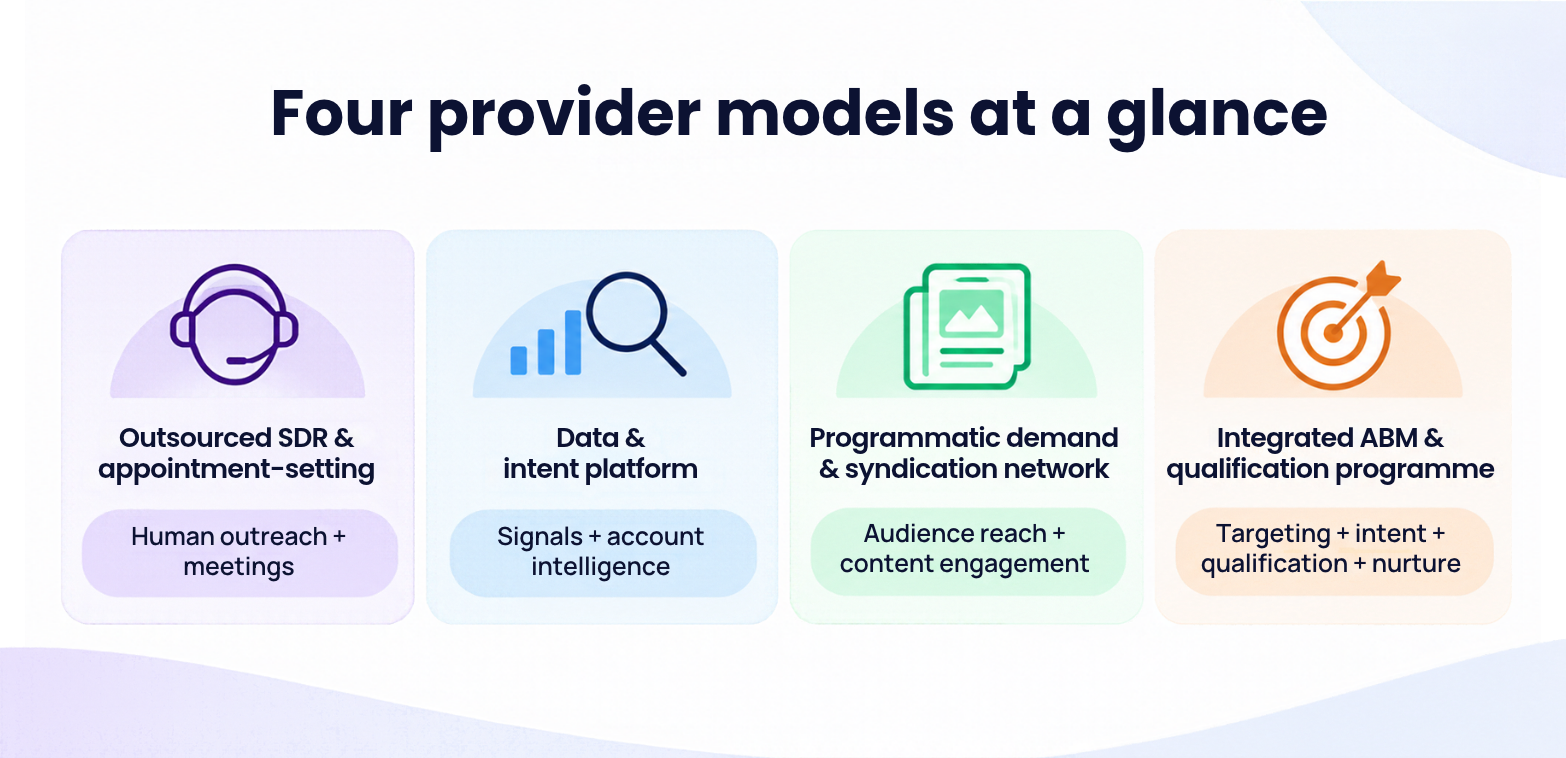
Outsourced SDR and appointment-setting firms. Callbox, Belkins, CIENCE, MemoryBlue and Leadium all appear on current comparison lists in this group. They add human conversation and book meetings. Ask how many contacts they work per account, because the model is built around the meeting.
Data and intent platforms. ZoomInfo, 6sense and Demandbase sit here. You license the platform, and your team runs the programme. That suits teams with strong outreach capacity and a mature sales and marketing engine. A platform-led model may be less suitable if you need a partner to manage the conversations as well as the intelligence.
Programmatic demand and syndication networks. Providers in this category typically help brands reach target accounts through content syndication and demand programmes. When reviewing a proposal, ask how data validation, nurturing, qualification and CRM handoff are handled.
Integrated ABM and qualification programmes. These providers combine account targeting, intent evidence, human qualification and nurturing in one managed programme. Think ABM sits in this group. We aren't a database licence or an outbound SDR firm.
Seven criteria to compare every provider
Use the same seven questions with every provider. Put the answers side by side before you look at price.
| Criterion | What to ask for | Red flag |
|---|---|---|
| Account targeting | Delivery against your named target account list, with a report showing accounts reached and not reached | Leads from accounts outside your list |
| Intent evidence | The signal behind each lead, shown at record level | "Intent-based" with no signal you can inspect |
| Human qualification | Who checks each lead, against which criteria, and what gets rejected | Qualification based on a form fill alone |
| Buying-committee coverage | Number of contacts and roles per account | One contact per account, always the same role |
| Nurturing | What happens to engaged contacts who aren't ready to talk | Leads handed over once, then silence |
| CRM handoff | Fields, lifecycle stages and routing mapped before launch | Spreadsheets sent by email |
| Reporting | Acceptance rate, MQL-to-SQL conversion and cost per qualified opportunity, not just clicks | Reports that stop at CTR and lead count |
If a provider includes events or webinars in the programme, separate registration, attendance and qualified follow-up in your reporting. A registration alone isn't a qualified lead.
How the four models usually compare
This table reflects how each model is typically positioned. It isn't a score. Check every cell against the provider's proposal.
“Varies" isn't a criticism. It means you need to ask, and the answer will vary by provider. Integrated programmes bundle these elements, but the depth differs too. A platform gives you more control, and an SDR firm gives you more direct conversation. Weigh that against the managed support an integrated programme offers.
Test the shortlist with a controlled pilot
Use a defined segment, a shared brief and written acceptance criteria. Review an early delivery sample with Sales before expanding volume. If you test two providers, minimise differences in account fit, content, sales treatment and review timing so the comparison is useful.
Enterprise revenue outcomes often take longer than a pilot. Evaluate data accuracy, targeting, evidence quality and follow-up first. Track opportunity progression later, and distinguish newly sourced pipeline from influence on existing opportunities.
What the evidence looks like
Any provider can claim quality. Ask for acceptance and conversion data, with the baseline stated.
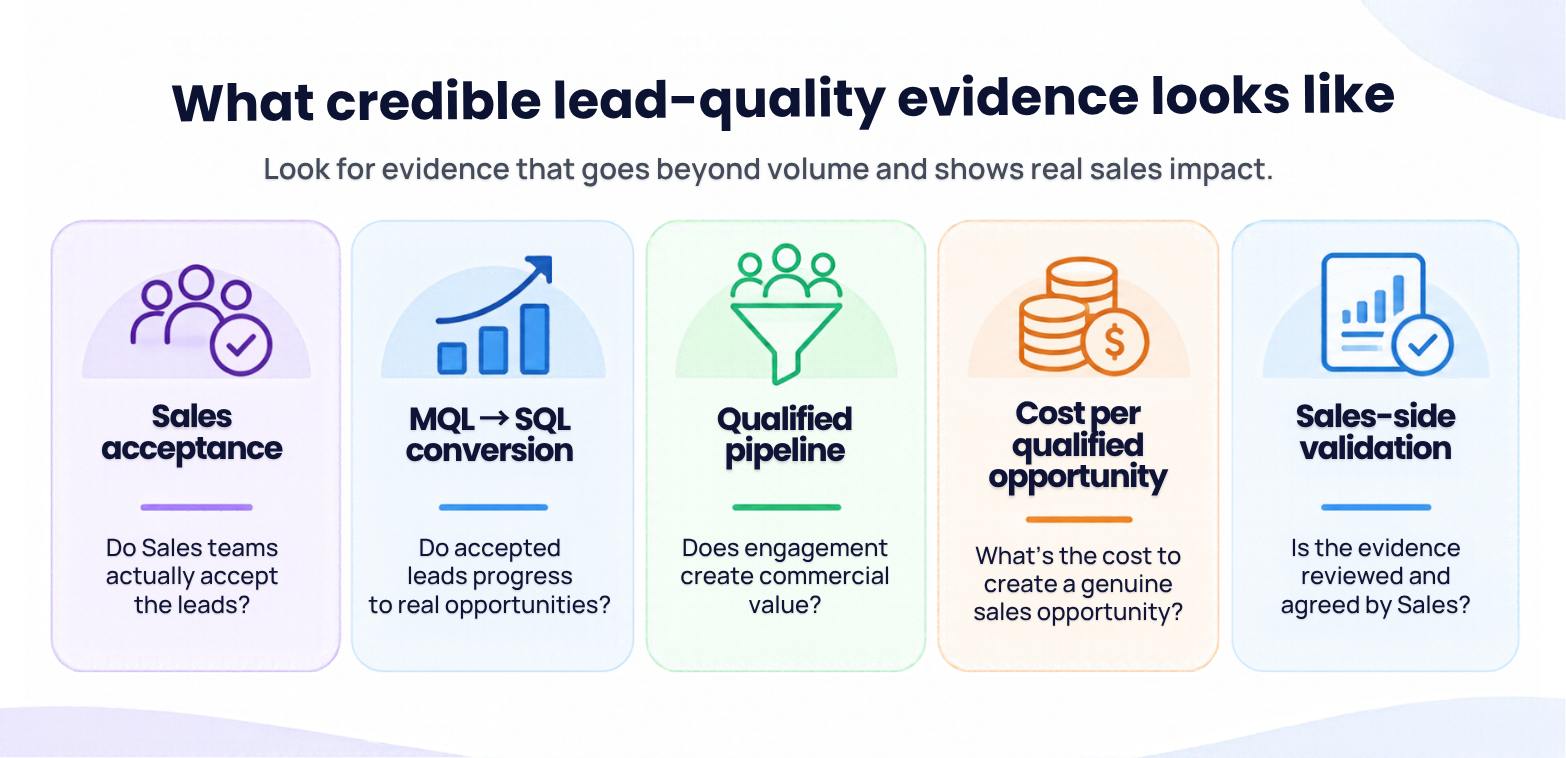
Here are anonymised examples from Think ABM programmes. The figures are client-reported.
- Enterprise cybersecurity provider
A 118% lift in SQL conversion versus the previous ABM programme. A double-touch content engine verified engagement, followed by human validation before handoff. - Enterprise SaaS platform
$2.5M in pipeline from $18K of spend in Latin America. Every contact was human-validated, with BANT-level tele-verification used to reduce noise before delivery. - Enterprise identity security leader
A 63% increase in MQL conversion and a 41% reduction in cost per MQL, with $4.2M+ in qualified pipeline. The programme combined content, webinars and display, with messaging matched to buyer intent stage. - Global CX software provider
A 99.6% lead acceptance rate, based on Sales review against agreed qualification criteria. The programme used strict ICP targeting and a qualification-first approach. - Global spend-management technology provider
An 82% lift in MQL-to-SQL conversion across 48+ campaigns, with every lead validated for fit and engagement before delivery.
Read these with care. Baselines differ, programmes differ, and your results will too. What matters is the type of evidence being provided. Ask every provider on your list for acceptance rates, stated baselines and evidence of Sales-side review. Client references will be provided on request, where confidentiality and client approval allow.
Choosing the right partner for your programme
Choose a B2B lead generation company whose delivery model matches the work you need done and whose evidence your Sales team can inspect. A larger audience, a lower cost per lead or a booked meeting isn’t enough to establish that fit.
At Think ABM, our Qualified Lead Generation offering is built on BANTIQ™, our qualification approach. It checks budget, authority, need and timing, then adds intent evidence and human validation from our team of 100+ analysts. Every lead passes a three-stage quality check before delivery. Leads also include an InsightsIQ™ persona profile, providing additional guidance on how someone may prefer to engage.
Discuss your target accounts and sales-acceptance requirements with Think ABM.
Psychological precision. Better conversations.
Frequently Asked Questions
Which is the best B2B lead generation company for enterprise technology?
There is no universal best provider. Compare audience access, execution capacity and qualification against your target accounts and the outcome you need. Use the shortlist to identify suitable models, then validate the proposed delivery through a pilot.
Does content syndication produce qualified leads?
It can, but a content interaction alone isn't proof. Check whether the programme includes qualification, relevant stakeholder context and an agreed next step. If it doesn't, those leads should enter nurture first.
What should a lead generation proposal include?
It should define targeting, exclusions, engagement sources, qualification, delivery fields, service responsibilities, reporting, commercial terms and acceptance rules. Ask for an anonymised handoff sample and a relevant technology-sector example.
Can a provider guarantee sales acceptance?
A contract can define acceptance standards and what happens when a lead fails to meet them. That is different from guaranteeing opportunity creation or revenue. Sales must still review the evidence and validate the buying situation.